
Waste Elimination and Management Policy
Atılım University recognizes that waste management plays a crucial role in reducing its environmental footprint and providing a safe and healthy working environment for academic and administrative staff, students, and visitors. The university ensures that all campus waste is eliminated responsibly at source through appropriate waste separation mechanisms and, where possible, converted into value-added, environmentally friendly products. Our policy demonstrates our commitment to ensuring that all waste generated within the university is managed and disposed of safely and effectively within the scope of the zero waste action plan for Turkish universities. We are committed to implementing and implementing best waste management practices while reducing the negative environmental impacts of waste.
The policy emphasizes the implementation of effective and responsible waste management and disposal processes that meet all environmental regulations for a sustainable society. Waste management plays a crucial role in protecting human health and resources, as well as in the global goal of cleanliness and environmental sustainability. Waste management and elimination process is a general term depicting the entire range of waste-related activities undertaken by Atılım University Coordination Office of Auxiliary Services, including the production, separation, storage and transportation of waste from the source point to the disposal site.
The university embraces a zero-waste approach by embracing the idea of a circular economy, focusing on waste prevention, reuse, and recycling with resources.
Atılım University aims to reduce the unnecessary use of raw materials, implement product reuse, reduce total annual waste production across all waste streams, and reduce waste sent to landfill through recycling and composting. Atılım University strives to transform lives and serve society through the pursuit of excellence in teaching, innovation, lifelong learning, cultural enrichment, and promotional services. The policy provides the framework for the University to manage its financial resources more effectively through increased efficiency, cost savings, lower environmental impact and associated supply chain and carbon reductions.
Policy Implementation
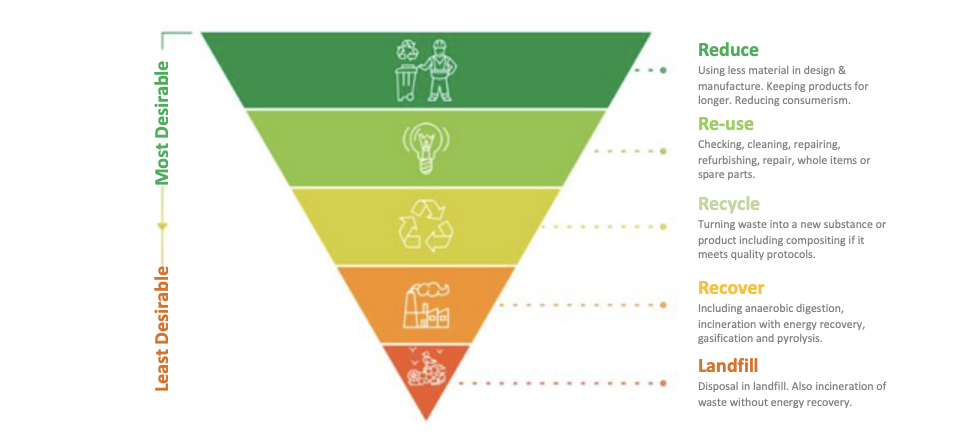
Atılım University implements a policy to promote waste as a resource, and encourage its reuse and recycling in accordance with the waste hierarchy. The university shall have adequate regulations, facilities, infrastructure, necessary logistics, and elimination / recycling infrastructure, and all students and staff will utilize these facilities to help eliminate and recycle as much waste as possible. Atılım University manages its waste and disposal process with circular economy principles based on the European Union and the waste hierarchy system, ensuring that appropriate procedures are in place to manage all waste streams. The university adopts and implements a hierarchical approach to reduce, reuse, recycle, and recover waste products, prioritizing elimination. Atılım University members take reasonable steps to comply with the waste hierarchy system and evaluate all options, with an emphasis on prevention and reduction; elimination is a last resort.
Policy Scope
The scope of the waste management and elimination policy supports the intended emphasis on United Nations Sustainable Development Goals 3, 9, 11, 12, 14, and 15. The scope of this policy covers solid waste generated (paper, plastic, electronics, organic, medical, raw materials, and hazardous waste) and the policy applies to everyone on the university campus. The policy applies to all staff and students residing on campus, as well as university guests and other campus visitors. Atılım University suppliers, providers, and waste elimination companies are also responsible and must comply with this policy.
Policy Statement
Atılım University is committed to managing the waste generated on the MOG campus in an environmentally safe and sustainable manner, in accordance with current environmental conditions, and recognizes the critical role that waste management plays in developing a sustainable environment. The university is committed to fostering positive change and ensuring that all campus activities related to waste management principles and practices are organized with a commitment to further reducing the environmental impact of waste by ensuring its effective and sustainable management.
Atılım University will ensure that waste management activities comply with relevant procedures for all waste streams and will aim to maintain a zero-landfill system. The university has created a green campus that sets a good example among foundation universities in its commitment to environmental sustainability through its commitment to sustainability and clarity in consumption.
This policy aims to promote the concept of “Zero Waste”, an important agenda under the auspices of the Ministry of Environment, Urbanization and Climate Change of the Republic of Türkiye, on university campuses with the philosophy of 5R (Refuse, Reduce, Reuse, Repurpose, and Recycle) to reduce the impact of various wastes generated on campus on the environment and human health. In this context, Atılım University recognizes the importance of meeting the requirements and managing its waste responsibly, reducing the volume of waste sent for elimination and maximizing reuse and recycling where possible.
Policy Objectives
Atılım University aims to enhance the quality of life and well-being of higher education staff and students, making the MOG Campus a preferred place to live and study through the following key objectives:
- Aiming to reduce the amount of waste generated and associated environmental impacts by applying the principles of the waste management hierarchy
- Providing facilities for the safe processing, effective separation, and safe storage of waste across all campuses
- Setting goals and objectives for minimizing waste, improving recycling rates, and reducing waste disposed of in landfills
- Providing appropriate training and orientation to staff and students on waste practices and site-specific requirements
- Using reuse schemes for existing furniture during cleaning and opening new spaces, and carrying out renovations to reduce waste generation from project work.
- Reducing the amount of unnecessary single-use plastics and other disposable items used on campus by collaborating with suppliers, such as catering contractors
- Reducing negative environmental impacts and waste costs by ensuring waste and resource use are considered in the procurement process
- Working with companies and suppliers to reduce waste generation and increase the amount of recycling that occurs at each facility
- Ensuring adequate training and awareness programs are in place for staff and students to promote environmental awareness and support waste reduction
- Continuing to work with relevant internal parties, such as our student union and staff, to improve on existing waste management procedures
- Avoiding or limiting the use of environmentally harmful substances, materials, and processes; eliminating these substances if and when produced
- Minimizing waste generation at source and implementing cost-effective repair, reuse, and recycling processes instead of elimination.
- Ensuring that health and safety risks associated with waste generation, storage, and off-site disposal are minimized for staff and students.
- Implementing initiatives that divert all organic waste from landfills, and on-campus composting.
- Investing in expanding recycling opportunities on the university campus and transforming waste into value-added products.
- Monitoring and auditing waste management and elimination processes with data in order to reduce waste and increase recycling annually.
- Ensuring that waste is managed in accordance with all waste legislation requirements, including certifications and a plan that reflects future legislative changes.